Skip to content
How it works
- It generates all 1,820 possible 4-word groups from a 16-word board and scores them using a combination of semantic embeddings and rule-based heuristics.
- Uses pretrained SentenceTransformer embeddings to represent each word as a normalized vector, then scores each 4-word group by computing pairwise cosine similarities, and then calculates the average of the group.
- Built a multi-stage pruning pipeline (top # of solutions selection + per-word frequency caps) that reduced the effective search space by 90%+ while preserving valid solutions, dramatically decreasing solve times.
- Used a recursive backtracking algorithm that finds the combination with the highest total score with 4 disjoint groups.
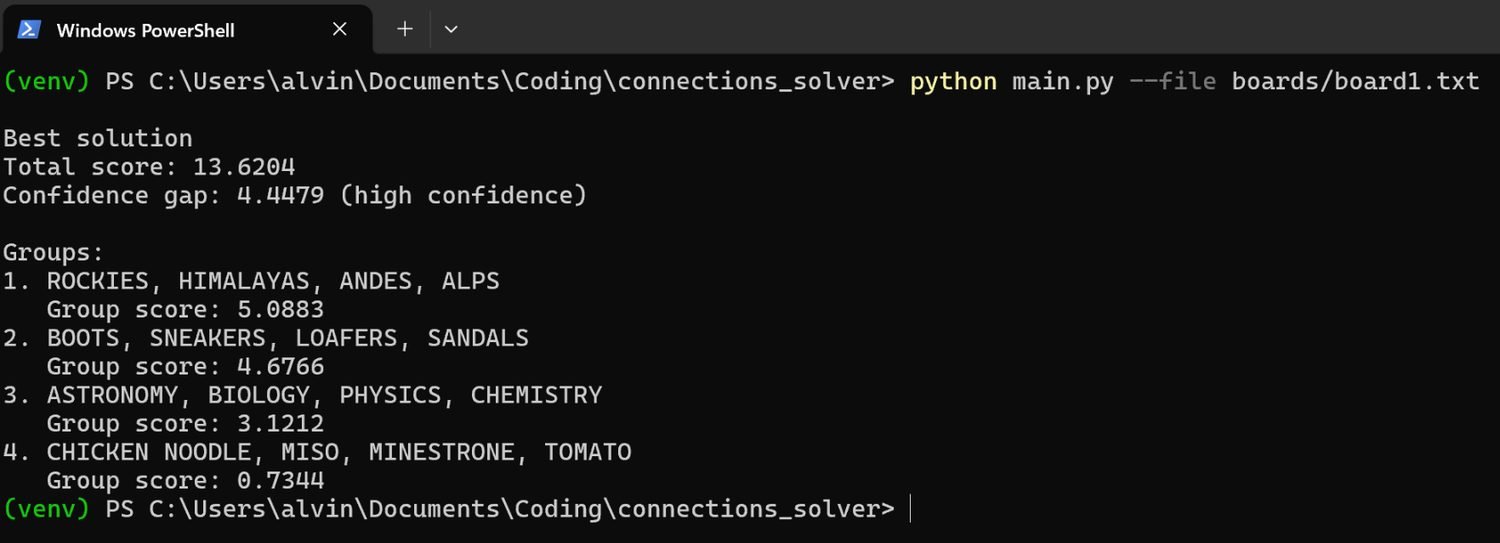
- Implemented an explain mode that breaks down each group’s score into average similarity, weakest pair similarity, and individual heuristic contributions.
- Coded heuristic features for common puzzle patterns (plural consistency, word-length consistency, anagrams, prefixes/suffixes) to compensate for limitations of pure semantic similarity.
- Refactored the solver core so both the CLI and web interface share the same pipeline, eliminating discrepancies caused by inconsistent normalization and thresholds.
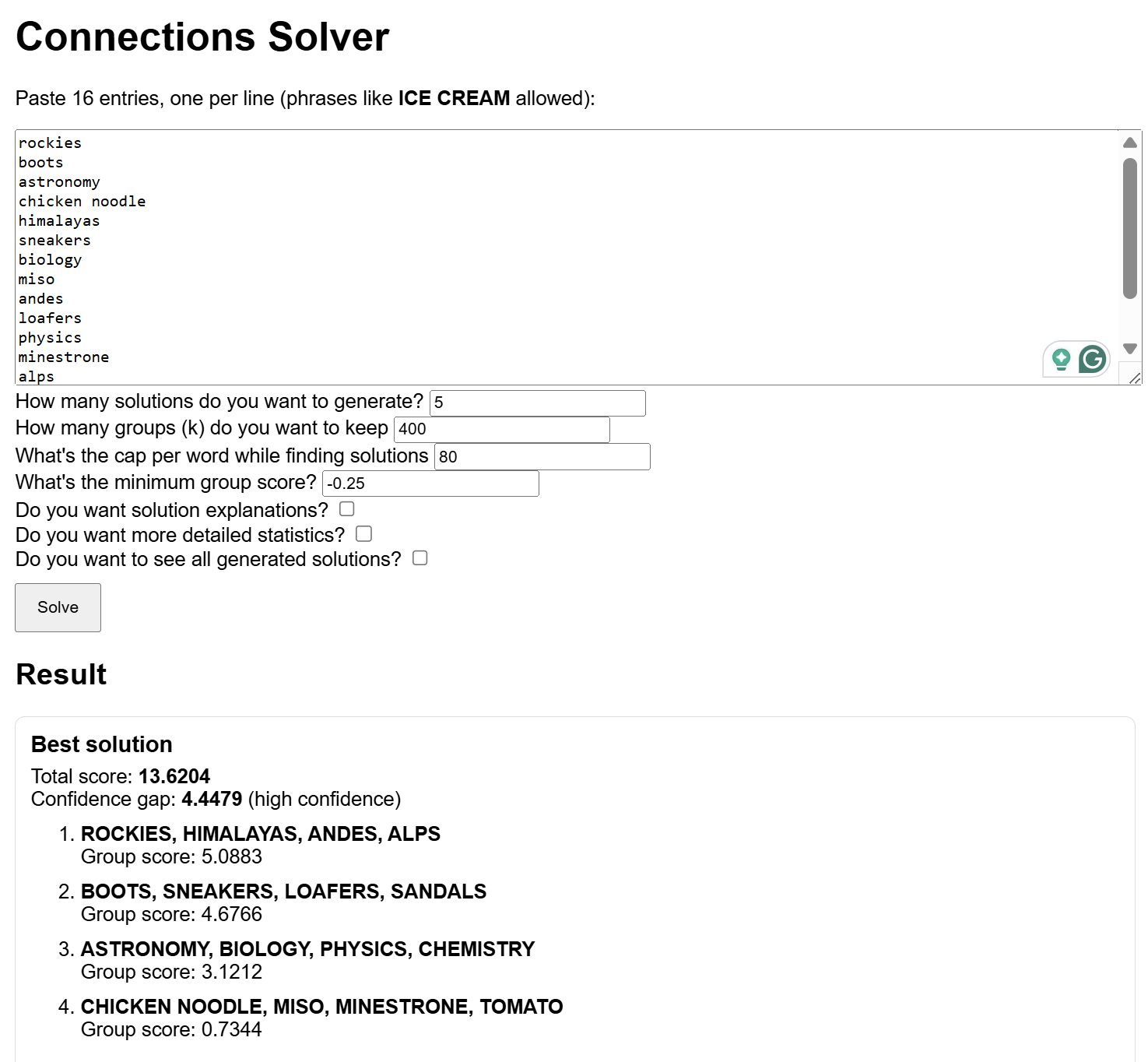
- Built a FastAPI backend with a clean /solve endpoint and JSON output.
- Implemented a browser-based frontend (HTML/JS) with robust input handling (multi-word phrases, whitespace normalization, validation) and readable error states.
Lessons learned
- Learned that raw embedding similarity is insufficient for combinatorial word puzzles and must be augmented with domain-specific heuristics.
- Gained experience debugging algorithmic correctness vs UI integration bugs, especially when exposing the same logic through multiple interfaces.
- Practiced designing systems that fail gracefully, providing confidence indicators and explanations instead of silent errors.